Sold and catalogued as a vehicle part rather than a consumer product: the listing publishes dimensions and effective charging current, and asks you to check compatibility against your vehicle data.
The bottom line A parts-catalogue charger. The figures are real; the description is not written for you.
What lands on the bench
A 12 V charger listed in a parts catalogue, with an effective charging current of 5 A and its dimensions published.
Reading a parts listing
There is no marketing here, and no feature list either. What you get instead is a data table: input voltage, effective current, dimensions. Everything a consumer listing would say about modes and stages is simply absent, and absence is not the same as absence of the feature — it is absence of the sentence.
What that means in practice
Ask the seller, or choose a charger whose listing states its chemistry modes. On this shelf, the chargers that name AGM and float are the ones that can be recommended for a modern car without qualification.
The reason to buy it anyway
A part number. It will still exist in ten years, and so will the spares.
Availability
On sale from 68 € to 79 € on the German, French, Italian and Spanish Amazon stores at the time of checking.
Listed but with no offer on the American Amazon store — the reference exists there and nobody is currently selling it.
Not found on the British Amazon store, where the buy link falls back to a local search rather than to a page that does not exist.
Prices and availability are what Keepa reported on the date this page was updated; both move.
Prices quoted in this text were read on 4 September 2026. The live price is at the top of the page.
What we like, and what we don't
Strengths
Publishes an effective charging current rather than a peak, which is the honest figure
Physical dimensions published — useful when it lives in a fixed place
A part number that will still be orderable in a decade
Compromises
The listing is a parts-catalogue entry: no chemistry modes, no stage description, no display detail
5 A effective suits batteries around 50 Ah at the rate makers commonly state
Buying a charger from a parts listing means reading a data table rather than a description
Specifications
Effective charging current
5 A, stated
Input voltage
14.7 V, stated
Dimensions
169 × 81 × 54 mm, stated
Listing type
Catalogued as a vehicle part — the maker asks buyers to check compatibility against their vehicle data
Amazon reference
B0CGJ8TLYZ (same reference on 5 Amazon marketplaces)
EAN
4047026640441
Questions people actually ask
Why does the listing warn about compatibility?
Because it is a parts-catalogue entry, and Bosch applies the same warning to every reference sold that way. For a charger it matters less than for a component, and it is still the maker asking you to check.
Is 5 A enough?
At the rate makers commonly state — around a tenth of capacity in amp-hours — 5 A suits a battery near 50 Ah. For a larger battery it simply takes longer.
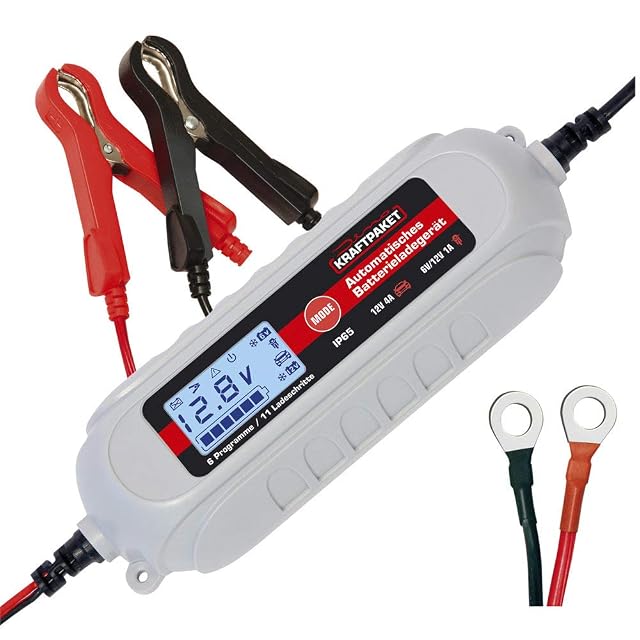
6 V and 12 V · 4 A · lead-acid, wet, MF, gel and AGM stated · built-in battery tester · float charge · memory after power cut
A maintainer with a battery tester built in: it names the chemistries it supports, holds a float charge, and remembers its programme after a power cut.
Best for: A second car, a classic or a motorcycle that stands between uses.
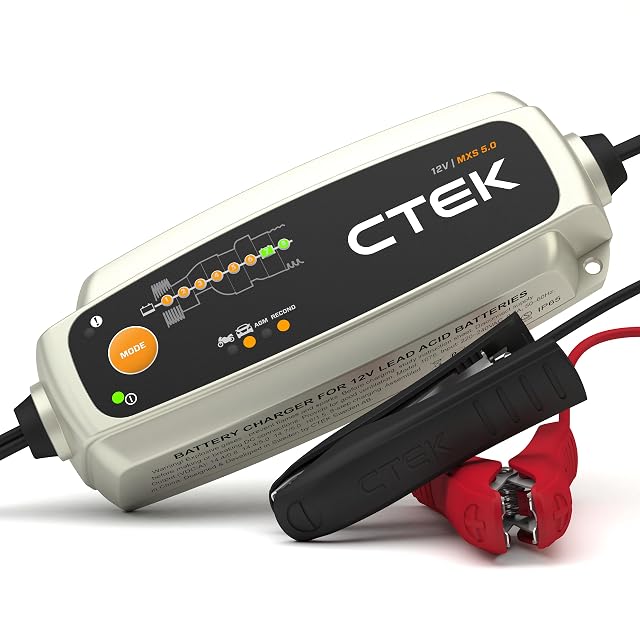
12 V · temperature compensation · RECOND recovery mode · AGM programme · from the maker of the first smart 12 V charger
The reference on this shelf: temperature compensation, a recovery mode for deeply discharged batteries, an AGM programme, and a charging profile used by more than forty vehicle manufacturers according to the maker.
Best for: Anyone who intends to own one charger for a decade, and anyone with an AGM battery.